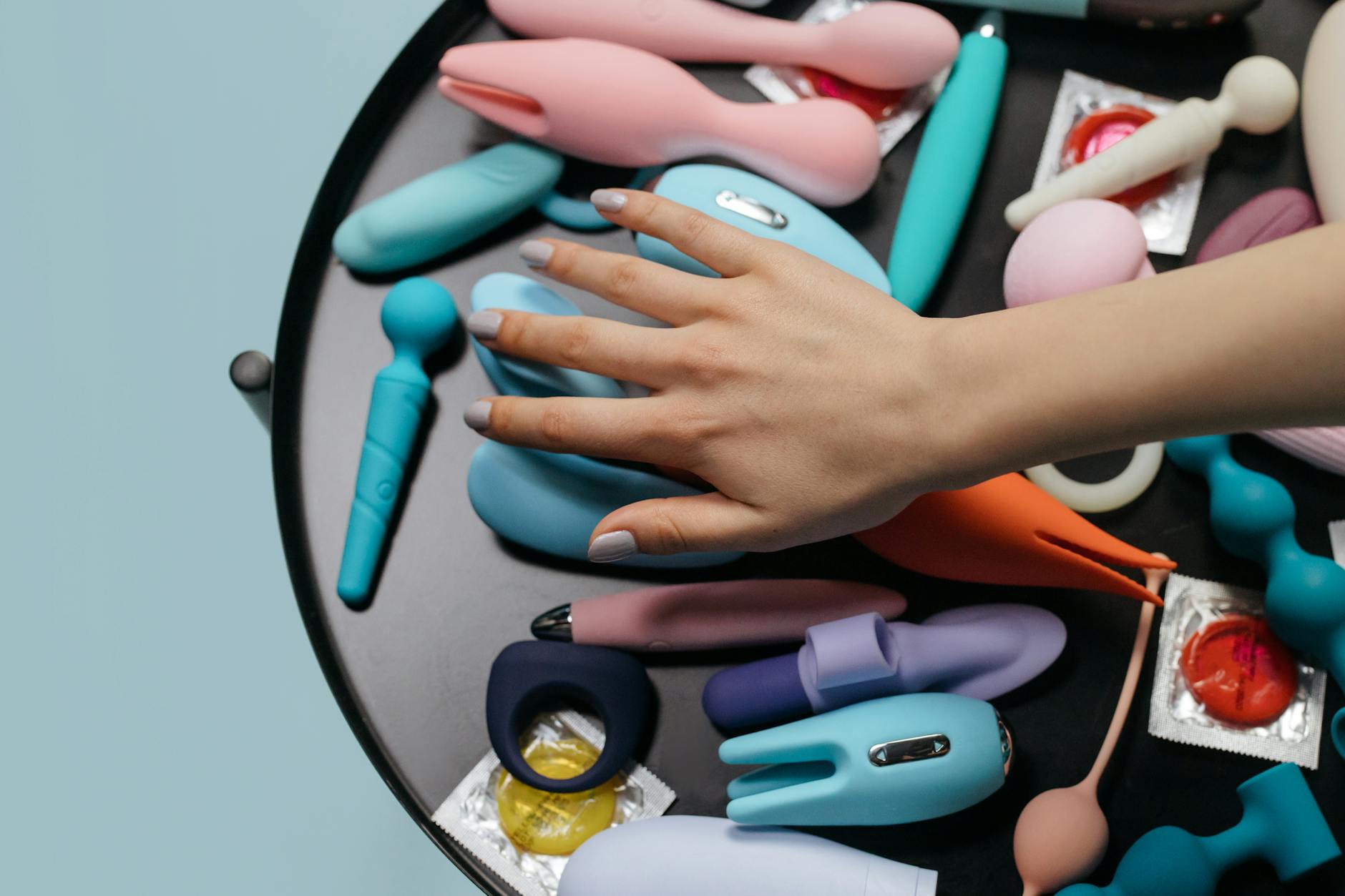
You're not imagining it
Somewhere around 42 or 43, pleasure starts feeling like you're watching it through frosted glass. Not gone. Just... quieter. You touch yourself the way you always have, and something's different. Maybe it takes longer. Maybe it feels like less. Maybe you finish and think, "That's it?" and feel oddly disappointed. Here's the thing: you're not losing your capacity for pleasure. You're entering perimenopause, and your nervous system is literally recalibrating.
I work with people in this exact phase all the time. The conversation usually starts the same way. "I don't know what's wrong with me." Nothing's wrong. Your estrogen is becoming erratic. Your progesterone is dropping. Your vulva tissue is getting thinner. Your clitoral blood flow is shifting. All of that changes the signal. Not the receiver.
Why sensation actually does change in perimenopause
Three hormonal things happen in early perimenopause that directly affect pleasure:
Estrogen becomes unpredictable. In your 20s and 30s, estrogen follows a rhythm. By your 40s, it stops. It spikes, it plummets, it flatlines. Your body never knows what to expect, so neither does your nervous system. This erratic hormone pattern makes arousal harder to predict and sensation harder to feel consistently. Some days you're fine. Some days nothing lands.
Your clitoral tissue gets thinner. Estrogen keeps vulva tissue plump and well-supplied with blood. Less estrogen means thinner tissue, less blood flow, and fewer active nerve endings near the surface. The clitoris itself doesn't shrink, but the sensation can feel dampened because the tissue it sits in has lost some of its responsiveness. This is why traditional vibrators that rely on direct friction suddenly feel less intense. You're not broken. The stimulus-to-sensation ratio has shifted.
Progesterone drops faster than estrogen. Progesterone is the calming hormone. When it falls faster than estrogen (which it often does in perimenopause), you get irritability, anxiety, and a nervous system that's easily overwhelmed. This makes intense direct stimulation feel jarring rather than pleasurable. Your threshold for "too much" gets lower even as your threshold for "enough" gets higher.
Understanding this matters because it changes how you approach toys. A lemon clitoral vibrator works differently in perimenopause than it did at 30, and that's not a flaw. It's information.
Why lemon vibrators specifically help during this phase
Traditional vibrators work by delivering consistent, direct mechanical vibration to the clitoris. That works fine when tissue is plump and blood flow is steady. In early perimenopause, direct vibration can feel overwhelming to a nervous system that's already jittery, and it can feel less pleasurable because the tissue itself isn't responding the way it used to.
Lemon suction toys (including the Lem Vibrator) work differently. Instead of vibration, they use rhythmic suction and gentle pulsing. Here's why that matters in perimenopause: suction stimulates the entire clitoral network, not just the external tip. The clitoris extends internally, and suction activates that deeper architecture. For people in perimenopause with thinning tissue and reduced surface sensitivity, this approach often feels more satisfying than traditional vibration alone.
The rhythm is also gentler. You control the intensity, which means you can start at patterns 1 or 2 and build up rather than being locked into the default setting. For a nervous system that's already dysregulated, that agency matters.
Another thing: suction doesn't require the same level of direct friction that wand vibrators or bullets do. If your tissue is sensitive or if direct pressure feels uncomfortable, suction bypasses that problem entirely. You get stimulation without the mechanical abrasion.
The practical setup that works in early perimenopause
If you're used to vibrators and you're trying a lemon clitoral vibrator for the first time during perimenopause, here's what actually helps.
Start with water-based lubricant, always. Even if you didn't need it before, you do now. This isn't about being dry in the clinical sense. This is about reducing friction and making every sensation feel better. A good water-based lube makes suction feel smoother and more pleasurable. I recommend a thick, silky formula rather than something watery.
Begin at the lowest setting. The Lem Vibrator has multiple patterns. Start at 1 or 2, not 5. Spend 5 to 10 minutes here. Your nervous system is adjusting, and low-intensity stimulation actually helps your body remember what pleasure feels like. This isn't wimpy. This is recalibration.
Budget time differently. In your 20s, you might have gotten there in 10 minutes. Now budget 20 to 30. Your body isn't slow. Your arousal pathway just needs more activation before the threshold clicks. This is normal. Once you accept the longer timeline, it stops feeling like a problem.
Combine it with fantasy or visual stimulus. Perimenopause is a time when mental engagement becomes essential. Your body can't rely on automatic arousal anymore. You have to actively think about what turns you on. That's not weakness. That's how pleasure works now. Give yourself permission to use whatever mental fuel works, whether that's fantasy, erotica, video, or partner participation.
Stop before you think you need to. This is counterintuitive, but perimenopause is when the nervous system benefits from stopping at 80 percent rather than pushing to 100. An orgasm at 80 percent satisfaction often feels better than an exhausted climax after 45 minutes of trying. Your body is recalibrating what pleasure actually is. Sometimes less intensity, less time, and less pressure creates more actual pleasure.
The emotional piece that nobody talks about
Here's what I see clinically: people in early perimenopause often blame themselves for muted sensation. "I'm getting old." "My partner isn't attractive to me anymore." "I've lost my sexuality." None of that is usually true. What's true is that your nervous system is in transition.
That transition can actually be an opportunity. If you've been using vibrators the same way for 15 years, perimenopause might be the first time you actually explore what you really want. Maybe you've never paid attention to the difference between clitoral orgasm and blended sensation. Maybe you've never spent 30 minutes on foreplay because you thought you didn't need to. Maybe you've never used a toy with a partner because you thought that meant you weren't enough.
Perimenpause asks you to be intentional about pleasure in a way you might not have been before. For a lot of people, that turns out to be the good part.
When to check in with a doctor
If sensation changes suddenly or if you develop pain where there was none before, see a gynaecologist. Genitourinary syndrome of menopause (GSM) is real and treatable, often with topical estrogen creams. If your experience shifts dramatically, get it checked. Most of the time it's just perimenopause doing its thing. Sometimes it's worth getting support.
If you're also dealing with anxiety, mood shifts, or sleep changes, those are part of perimenopause too. Addressing those often improves sexual sensation more than any toy will. Your nervous system's baseline state affects everything, including pleasure.
Starting again with intention
The shift into early perimenopause can feel like starting from scratch sexually. The good news is that you don't have to guess your way through. Lemon vibrators work well during this phase because they meet your nervous system where it actually is right now, not where it was at 30.
Give yourself permission to experiment. Start with low intensity and time. Use lube. Engage mentally. And remember: muted sensation in your 40s isn't the end of pleasure. It's just pleasure wearing a different shape.
People also ask
How long does it take to feel normal sensation again after perimenopause starts?
There's no fixed timeline. For some people, sensation stabilizes once they're fully into perimenopause (which can take 4 to 10 years, depending on the person). For others, sensation shifts gradually throughout perimenopause and then stabilizes in postmenopause. The key insight is that "normal" changes. Your baseline at 45 won't be the same as at 35, and that's okay. Many people find that once they stop fighting the change and start working with it, pleasure actually deepens.
Can I use a lemon clitoral vibrator if I'm already on hormone replacement therapy?
Absolutely. HRT can help restore some sensation by stabilizing estrogen, but it doesn't instantly reset your nervous system. Many people using HRT still benefit from lemon vibrators because the suction mechanism works well regardless of hormone status. If you're on HRT and sensation is returning, a lemon suction toy can actually help you explore that returning sensation in a controlled way. Start low, go slow, same as without HRT.
Does the Lem Vibrator work better than other toys during perimenopause?
Lem Vibrator's suction design works particularly well during perimenopause because it stimulates deeper clitoral tissue without requiring intense direct friction. That said, what works is individual. Some people in perimenopause do fine with traditional vibrators if they use them on lower settings and combine them with lube. The Lem Vibrator is a good choice if direct vibration feels overwhelming or if you're looking for a different sensation profile. Try what appeals to you.
Should I use a partner during this transition, or is it better to explore alone first?
There's no right answer. Solo exploration lets you figure out what you need without performance pressure. Partner exploration, if your partner is patient and communicative, can actually help rebuild intimacy during a transition that can feel isolating. If you have a partner, the best approach is usually to explore solo first, figure out what works, and then bring that information back to the relationship. That removes the pressure for them to magically know what your body needs now.
Is it normal to need longer warm-up time with lemon vibrators in perimenopause?
Completely normal. You're not slow or broken. Your arousal pathway just needs more activation now. This isn't true for everyone, but it's common enough that I mention it in almost every conversation about perimenopause and pleasure. If longer warm-up time bothers you, reframe it: you now get to spend more time on foreplay and anticipation, which a lot of people find more pleasurable anyway.
Can muted sensation during perimenopause mean my relationship is in trouble?
Not necessarily. Muted sensation is a hormonal shift, not a relationship signal. That said, perimenopause stress often lands in relationships because people misinterpret the change. If you think your partner suddenly isn't attractive, but the real issue is that your nervous system is recalibrating, that misinterpretation can create real relationship friction. The fix is communication: "My body is changing due to perimenopause. This isn't about you. Here's what I need." Once you separate the biological fact from the relationship narrative, most couples navigate this fine.
The conversation to have with yourself
Perimen pause changes pleasure, but it doesn't end it. The lemon vibrators and clitoral tools you use now might look different from the ones you used at 30, and that's okay. Your body is asking you to be more intentional, more patient, and more curious about what pleasure actually means to you now. That's not a loss. That's an upgrade, even if it doesn't feel like one yet. If you want to explore what works for your body during this transition, start with your own research and give yourself permission to experiment without judgment.